System realization via Hankel singular value decomposition.
Syntax
[a,b,c,d,totbnd,svh] = imp2ss(y)
[a,b,c,d,totbnd,svh] = imp2ss(y,ts,nu,ny,tol)
[ss,totbnd,svh] = imp2ss(imp)
[ss,totbnd,svh] = imp2ss(imp,tol)
Description
The function imp2ss produces an approximate state-space realization of a given impulse response
imp=mksys(y,t,nu,ny,'imp');
using the Hankel SVD method proposed by S. Kung [2]. A continuous-time realization is computed via the inverse Tustin transform (using bilin) if t is positive; otherwise a discrete-time realization is returned. In the SISO case the variable y is the impulse response vector; in the MIMO case y is a N+1-column matrix containing N + 1 time samples of the matrix-valued impulse response H0, ..., HN of an nu-input, ny-output system stored row wise:
 The variable tol bounds the H
 norm of the error between the approximate realization (a, b, c, d) and an exact realization of y; the order, say n, of the realization (a, b, c, d) is determined by the infinity norm error bound specified by the input variable tol. The inputs
 ts, nu, ny, tol are optional; if not present they default to the values ts = 0, nu = 1, ny = (no. of rows of y)/nu,  . The output
  returns the singular values (arranged in descending order of magnitude) of the Hankel matrix:
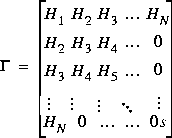 Denoting by GN a high-order exact realization of y, the low-order approximate model G enjoys the H norm bound
 where
where 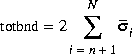
Algorithm
The realization (a, b, c, d) is computed using the Hankel SVD procedure proposed by Kung [2] as a method for approximately implementing the classical Hankel factorization realization algorithm. Kung's SVD realization procedure was subsequently shown to be equivalent to doing balanced truncation (balmr) on an exact state space realization of the finite impulse response {y(1),....y(N)} [3]. The infinity norm error bound for discrete balanced truncation was later derived by Al-Saggaf and Franklin [1]. The algorithm is as follows:
- 1
- Form the Hankel matrix
 from the data y.
- 2
- Perform SVD on the Hankel matrix

where  1 has dimension n x n and the entries of 2 are nearly zero. U1 and V1 have ny and nu columns, respectively.
- 3
- Partition the matrices U1 and V1 into three matrix blocks:
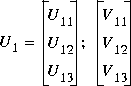
where  and
and  .
.
- 4
- A discrete state-space realization is computed as
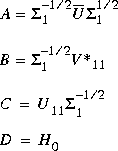
where
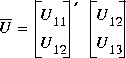
- 5
- If the sampling time t is greater than zero, then the realization is converted
to continuous time via the inverse of the Tustin transform

otherwise, this step is omitted and the discrete-time realization calculated in Step 4 is returned.
See Also
ohklmr, schmr, balmr, bstschmr
References
[1] U. M. Al-Saggaf and G. F. Franklin, "An Error Bound for a Discrete Reduced Order Model of a Linear Multivariable System," IEEE Trans. on Autom. Contr., AC-32, pp. 815-819, 1987.
[2] S. Y. Kung, "A New Identification and Model Reduction Algorithm via Singular Value Decompositions," Proc.Twelth Asilomar Conf. on Circuits, Systems and Computers., pp. 705-714, November 6-8, 1978.
[3] L. M. Silverman and M. Bettayeb, "Optimal Approximation of Linear Systems," Proc. American Control Conf., San Francisco, CA, 1980.
[ Previous | Help Desk | Next ]