bot),dim_in(top)) 
dim2| Mu Analysis and Synthesis Toolbox | Search Help Desk |
| starp | See Also |
Form the Redheffer star product of two VARYING/SYSTEM/CONSTANT matrices. The star product is a generalization of a linear fractional transformation
Syntax
sysout = starp(top,bot,dim1,dim2)
Description
Connects the two matrices top and bot in the star product loop shown below.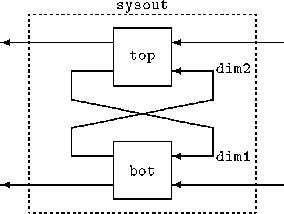
The last dim1 outputs of top are fed to the first dim1 inputs of bot, and the first dim2 outputs of bot are fed into the last dim2 inputs of top. The remaining inputs and outputs constitute sysout. By this description, the dimensions must satisfy
top),dim_in(bot)) dim1
min(dim_out(bot),dim_in(top)) dim2
Further restrictions also arise
In either case, it is unclear what to return as sysout, so it is returned empty. There is one exception to this situation. If either top or bot is a SYSTEM matrix with a nonzero number of states, and all of the equalities in the both of the above IF conditions hold (hence there are no inputs or outputs in the interconnection), then sysout will be a CONSTANT matrix, and will be the A matrix governing the internal dynamics of the loop.
out = starp(top,bot);then the operation is equivalent to
dim1 = min(ynum(top),unum(bot));
dim2 = min(unum(top),ynum(bot));
out = starp(top,bot,dim1,dim2);
Algorithm
The "m-Tools Commands for LFTs" section in Chapter 4 provides details of the star product formulae.Reference
Redheffer, R., "Inequalities for a matrix Riccati equation," Journal of Mathematics and Mechanics, vol. 8, no. 3, 1959.See Also
sysic