| Fixed-Point Blockset | Search Help Desk |
| FixPt Unit Delay |
This block provides a mechanism for discretizing one or more signals in time, or resampling the signal at a different rate. If your model contains multirate transitions, then you must add FixPt Unit Delay blocks between the slow to fast transitions. The sample rate of the FixPt Unit Delay must be set to that of the slower block.
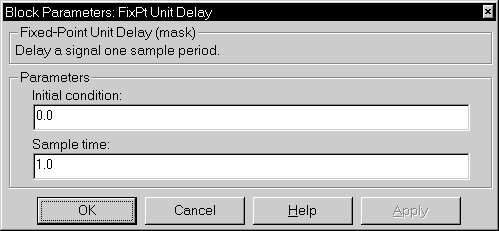
For fast to slow transitions, refer to FixPt Zero-Order Hold. For more information about multirate transitions, refer to the Using Simulink book or the Real-Time Workshop User's Guide.The block output for the first sampling period is specified by the Initial condition parameter. Careful selection of this parameter can minimize unwanted output behavior. The time between samples is specified with the Sample time parameter.
Note:
The FixPt Unit Delay block accepts continuous
sample times. When it has a continuous sample time, the block is equivalent
to the built-in Memory block.
Parameters and Dialog Box
Conversions
The Initial condition parameter is converted from a double to the input data type offline using round-to-nearest and saturation.