Calculate empirical standard deviations of nonparametric transfer function estimates.
Syntax
[tfm,stdAm,stdphm] = stdtfm(Fdat,vdat)
Description
For model validation purposes you may wish to calculate the nonparametric transfer function estimate tfm = ym./xm, and check the uncertainties of these values.
Fdat contains the Fourier data. It is either an array: [freqv,xm,ym], or a Fourier vector (see expfou), or the name of the Fourier file. The variances are defined by vdat. If this is an 1-by-2 or 1-by-3 vector, its elements are taken as constant input and output variances (and perhaps the input-output covariance). If this is an N-by-2 or N-by-3 array, the variance vectors (and perhaps the covariance vector) are formed from the two (or three) columns. If this is a vector, the variance and covariance vectors are obtained using impvar. If it is a string, the variance file is looked for.
tfm is the nonparametric estimate of the transfer function: tfm = ym./xm.
stdAm contains the approximate standard deviations of the absolute values of the transfer function. These are approximately equal to the standard deviations of the real and of the imaginary parts of tfm, if the distribution of the complex noises is circularly symmetric, as it is in the usual case.
stdphm returns the standard deviations of the phases in radians.
Examples
[tfm,stdAm,stdphm] = stdtfm('emachine.fbn','emachine.vbn');
Diagnostics
The routine checks the validity of the variance values and their compatibility with the frequency vector, and sends an error message when incompatibility is found.
Algorithm
stdtfm calculates the standard deviations by evaluating the formula
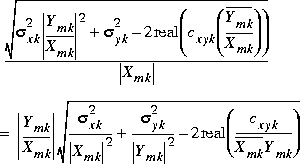 which gives the standard deviations of the real and of the imaginary parts of
 tfm. The output argument stdphm is obtained as stdAm./abs(tfm).
If the standard deviations of the estimate tfav = my./mx are sought, using the results of varanal, these can be obtained by vx/Na, vy/Na, and cxy/Na, respectively.
See Also
ploteltf
[ Previous | Help Desk | Next ]