Calculate standard deviations and covariances of poles and zeros of an identified transfer function, using the covariance matrix of the parameters.
Syntax
[zv,stdz,pv,stdp] = stdpz(pdat,cdat)
[zv,stdz,pv,stdp,rzp] = stdpz(pdat,cdat,zv0,pv0)
[zv,stdz,pv,stdp,rzp,g,stdg,dps] = ...
      stdpz(pdat,cdat,zv0,pv0,da,plm,dp,axv)
Description
If the covariance matrix of a set of estimated parameters is given, the uncertainties of the zeros and poles can be calculated. pdat is the parameter vector, usually generated by elis, or the name of a parameter file (see exppar). cdat is the covariance matrix, corresponding to pdat, in the form of an array, as generated by elis, or in the form of a vector (see expcov), or the name of a covariance file.
zv and pv are the column vectors of the zeros and poles, respectively, and stdz and stdp contain the corresponding uncertainties. In each row there are three elements: the standard deviation of the real part, the standard deviation of the imaginary part, and the correlation coefficient between the real part and the imaginary part of the corresponding zero or pole.
For multiple zeros or poles the standard deviations cannot be determined by analytical differentiation; in such a case the corresponding standard deviations are given as NaN.
For the investigation of the interrelations of different poles and zeros, a correlation coefficient matrix of the real and imaginary parts of all zeros and poles and the two gain values can also be obtained in rzp. The order of the random variables in the corresponding random vector is: real part of the first zero, imaginary part of the first zero, real part of the second zero, etc., then the real part of the first pole, etc. The last two elements are the leading coefficients of the numerator and the denominator.
g contains the leading coefficients of the numerator and the denominator. The standard deviations of the gain values and their correlation coefficient are given in stdg.
Sometimes it is desirable to prescribe the order of the poles and zeros in zv and pv. This can be done by giving zv0 and pv0. Any of these input arguments may be given as an empty variable, if the order need not be prescribed.
stdpz allows the use of numerical differentiation in the calculation of the zero/pole sensitivities to variations of parameters. It can check whether variations of the parameters, in the order of the standard deviations, cause the same changes in the positions of zeros and poles, as calculated from the analytical sensitivity calculations. The numerical differentiation can be requested by giving da with the value 'num'.
The amount of perturbations can be influenced by dp. By default, its value is 1, which means perturbations equal the eigenvalues of the covariance matrix, in the directions of the eigenvectors. These steps can be multiplied by a given value dp. When the perturbations are too large, the zeros and poles cannot all be paired to their nearest neighbors in the perturbed sets, and a suggested value of dp, for which all zeros and poles can be paired to their nearest neighbors, will be given in dps; otherwise dps will be equal to the actual value of dp.
The perturbed sets of zeros and poles can be plotted on the screen. If plm is given with value 'mc', the perturbed sets and the pairing will be shown on the screen, one after the other. For the value 'mp', a statement pause will be executed after each pairing. The axis vector for these plots may be given in axv.
Default Argument Values
zv0 = [], pv0 = [], da = 'anal', dp = 1, plm = ''.
Examples
[pvect,fit,Cp] = elis('inpchans.ebn');
[zv,stdz,pv,stdp,rzp] = stdpz(pvect,Cp);
Diagnostics
The standard deviations cannot be calculated by analytical derivation for multiple zeros or poles; in such cases the corresponding standard deviations will be given as NaN.
Algorithm
The sensitivity matrix of zeros and poles on the coefficients of the corresponding polynomials is calculated using
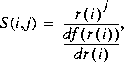 where r(i) is the ith root of the polynomial f(r(i)). The covariance matrix of the real and imaginary parts of the poles/zeros is calculated multiplying the covariance matrix of the parameters by the sensitivity matrix from both sides.
For numerical derivation, perturbations of the parameter vector are introduced in the direction of each eigenvector of the covariance matrix, with step sizes equal to the corresponding eigenvalue, multiplied by
where r(i) is the ith root of the polynomial f(r(i)). The covariance matrix of the real and imaginary parts of the poles/zeros is calculated multiplying the covariance matrix of the parameters by the sensitivity matrix from both sides.
For numerical derivation, perturbations of the parameter vector are introduced in the direction of each eigenvector of the covariance matrix, with step sizes equal to the corresponding eigenvalue, multiplied by dp. The original and perturbed sets are paired to each other by using pairs, with p = 1. This means that even for the multiple zeros or poles a standard deviation will be calculated, which will be in the order of the actual movements caused by the uncertainty of the parameters.
See Also
plotelpz
References
[1] P. Guillaume, J. Schoukens and R. Pintelon, "Sensitivity of roots to errors in the coefficients of polynomials obtained by frequency-domain estimation methods," IEEE Trans. on Instrumentation and Measurement, Vol. 38, No. 6, pp. 1050-1056, Dec. 1989.
[ Previous | Help Desk | Next ]