Discrete interval binary sequence design.
Syntax
bitser = dibs(N,dt,freqv,ampv)
[bitser,ampopt,Puf,Ptot] = dibs(N,dt,freqv,ampv,trialno,graphmod)
[bitser,ampoptn] = dibsimpr(bits0,dt,freqv,ampv)
[bitser,ampoptn,Puf,Ptot] = ... dibsimpr(bits0,dt,freqv,ampv,itno,graphmod)
Description
dibs generates a zero-mean discrete interval binary sequence of length N, with interval size dt, approximating the power spectrum given in ampv for the frequency points freqv. The algorithm is started trialno times from random starting values. The iteration can be followed on the screen, unless graphmod is given with a value 'nograph'.
The bit sequence (values ±1) is returned in bitser, and the complex amplitudes of the generated sequence at the points freqv in ampopt. The complex amplitudes are scaled in such a way that the total power of the designed signal equals the total power Ptot, defined by ampv.
In order to have a measure of the quality of the design, a so-called "equivalent crest factor" is calculated (it is shown in the plots). The basic idea is as follows. The crest factor of a zero-mean binary signal is 1. However, in our case the spectrum is not equal to the desired one, it only approximates it. If the smallest relative amplitude is increased to 1, by amplification of the binary signal, in order to assure that the system is excited at each frequency at least at the desired level, the peak value is multiplied by the reciprocal of the smallest relative amplitude: eqcr = max(abs(ampv./ampopt)).
Puf gives the useful power (the sum of the power at the desired lines), as a fraction of the total signal power, that is, the theoretical maximum of Puf is 1. Ptot is the total signal power, calculated from ampv.
dibsimpr attempts to improve the properties of a discrete interval binary sequence given in bits0: it maximizes the smallest relative amplitude of the actual amplitude vector, normalized by ampv. The bit series is searched for improvements by changing the sign of a pair of bits: this search is started by itno times.
dibsimpr may take quite a long time. To make it possible to follow how it proceeds, each already processed bit is marked by a dot on the screen.
A typical example of the plot of dibs is shown in the next figure. trial is the serial number of the actual trial (or at the end of the iterations the serial number of the one in which the optimum was found), iter is the number of the iteration cycles in the given trial, trials is the total number of the trials (given in trialno), eq. cr is the "equivalent crest factor" (see above), N is the length of the bit series, and dt is the length of the sampling interval.
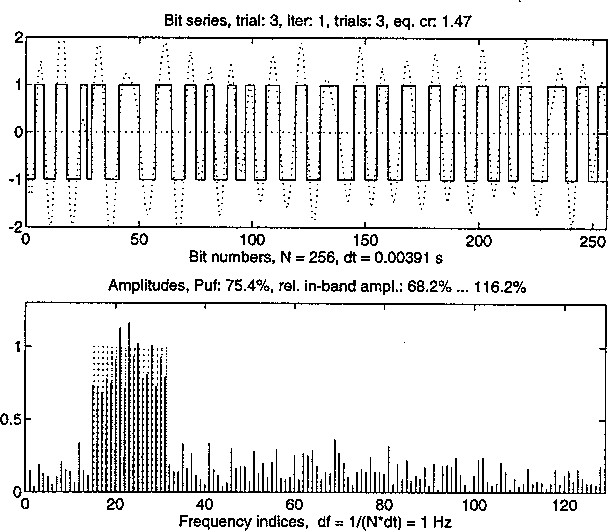 In the frequency domain plot the desired amplitudes are given by dotted lines, the actual ones by solid lines. Puf is the part of the total signal power, which is concentrated at the given frequencies. The minimum and maximum values of the relative amplitudes (actual amplitudes vs. the desired ones) are also given in percents. For these numbers the actual amplitudes are scaled to have the same total signal power as prescribed by
 ampv.
The frequency axis is scaled in "frequency indices," that is, the unit is df, the reciprocal of the period length.
The labels of the plots of dibsimpr are similar.
Default Argument Values
ampv = ones(size(freqv)), trialno = 25, graphmod = 'graph', itno = 1.
Examples
Let us assume that a system is to be excited at uniformly distributed frequency points between 500 Hz and 2 kHz, with 100 Hz resolution. A good choice for the sampling frequency is four times the highest harmonic defined in freqv. A possible program is as follows:
freqv = [500:100:2e3];
fs = 4*2e3; N = round(fs/100); %N = 80
bits0 = dibs(N,1/fs,freqv,[],10);
bitser = dibsimpr(bits0,1/fs,freqv);
bitser can be directly used for the control of a relay, a thyristor, etc.
Diagnostics
The sizes of freqv and ampv must be the same, otherwise an error message is generated:
freqv and ampv must have the same size
Since the discrete interval binary sequence is periodic, the frequency components must be at the points k/T, where T is the period length. If N, dt and freqv are inconsistent, the error message is:
a df value in freqv is smaller than 1/(N*dt)
The condition of the sampling theorem must be fulfilled, further the elements of freqv must be non-negative, otherwise an error message is sent:
freqv is out of range
dibsimpr iterates until the maximum iteration number is reached, or no further improvement is found. In this latter case an information message is sent:
dibsimpr cannot further improve signal
Algorithm
dibs is based on [1], with the modification that the returned signal is the one with the largest minimum relative amplitude. The algorithm generates a multisine with the amplitudes in ampv, takes the sign of the time function, combines the obtained phases with the given amplitudes, generates a new multisine, and so on. The mean value of the binary signal will be kept equal to zero if N is even, or will be equal to ±1/N if N is odd.
dibsimpr changes the sign of two intervals of length dt at a time, observing the change in the minimum relative amplitude [2].
See Also
mlbs
References
[1] A. van den Bos and R. G. Krol, "Synthesis of Discrete-Interval Binary Signals with Specified Fourier Amplitude Spectra," International Journal of Control, 1979, Vol. 30, No. 5, pp. 871-884.
[2] K.-D. Paehlike and H. Rake, "Binary Multifrequency Signals -- Synthesis and Application," Proc. 5th IFAC Symposium on Identification and System Parameter Estimation, Darmstadt, FRG, Sept. 24-28, 1979. Vol. 1, pp. 589-596.
[3] K. R. Godfrey, ed.: Perturbation Signals for System Identification. Englewood Cliffs, Prentice-Hall, 1993.
[ Previous | Help Desk | Next ]