| DSP Blockset | Search Help Desk |
| RLS Adaptive Filter | See Also |
Compute filter estimates for an input using the RLS adaptive filter algorithm.
Library
Adaptive Filters, in FilteringDescription
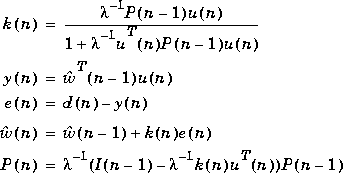
The RLS Adaptive Filter block recursively computes the least-squares estimate (RLS) of the FIR filter coefficients based on an externally generated error signal. The corresponding RLS filter is expressed in matrix form as
 -1 denotes the inverse exponential weighting. The variables are as follows
Adapt input port is added when the Adapt input check box is selected in the dialog box. When this port is enabled, the block continuously adapts the filter coefficients while the Adapt input is nonzero. A zero-valued input to the Adapt port causes the block to stop adapting, and to hold the filter coefficients at their current values until the next nonzero Adapt input.
Note that the implementation of the algorithm in the block does not precisely parallel the above equations; symmetry of the inverse correlation matrix P(n) is exploited to decrease the total number of computations by a factor of two.
The FIR filter length parameter specifies the length of the filter that the RLS algorithm estimates. The Memory weighting factor corresponds to in the equations, and specifies how quickly the filter "forgets" past sample information. Setting =1 specifies an infinite memory; typically, 0.95 
1.
The Initial value of filter taps specifies the initial value  as a vector, or as a scalar to be repeated for all vector elements. The initial value of P(n) is

 is specified by the Initial input variance estimate parameter.
Dialog Box
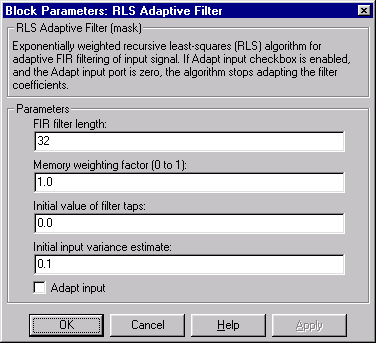

[0,1]. A value of 1 specifies an infinite memory.Adapt port.References
Oppenheim, A. V. and R. W. Schafer. Discrete-Time Signal Processing. Englewood Cliffs, NJ: Prentice Hall, 1989. Proakis, J. and D. Manolakis. Digital Signal Processing. 3rd ed. Englewood Cliffs, NJ: Prentice-Hall, 1996.See Also
Kalman Adaptive Filter
 , the vector of filter-tap estimates