
| DSP Blockset | Search Help Desk |
| LPC | See Also |
Determine the coefficients of a one-step forward linear predictor.
Library
Signal Operations, in General DSPDescription
The LPC block determines the coefficients of a one-step forward linear predictor by minimizing the prediction error in the least-squares sense. A linear predictor is an FIR filter that predicts the next value in a sequence from the present and past inputs. This technique has applications in filter design, speech coding, spectral analysis, and system identification. At the output port, the LPC block provides the coefficients of an nth-order moving average (MA) linear process that predicts the next value in the time-series u, contained in the length-L input frame.
 is the estimate of the next sequence value, and n is the Prediction order. The filter coefficients above are output in vector form, a = [1 a(2) ... a(n+1)]. If a value of
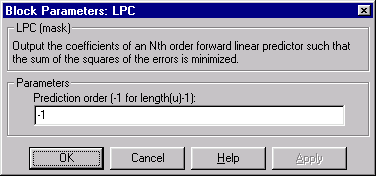
 -1 is specified for the Prediction order parameter, the block uses length(u)-1 for n.
A matrix input, u, is treated as a vector frame, u(:).
Algorithm
The LPC block computes the least-squares solution to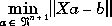
 indicates the 2-norm and
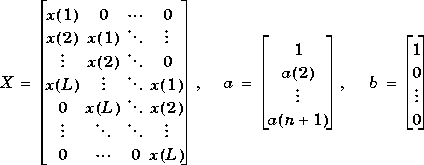

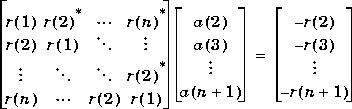
= [r(1) r(2) ... r(n+1)]T is an autocorrelation estimate for u computed using the Autocorrelation block, and * indicates the complex conjugate transpose. The normal equations are solved in O(n2) flops by the Levinson Solver block.
Note that the solution to the LPC problem is very closely related to the Yule-Walker AR method of spectral estimation. In that context, the normal equations above are referred to as the Yule-Walker AR equations.
Dialog Box
References
Haykin, S. Adaptive Filter Theory. 3rd ed. Englewood Cliffs, NJ: Prentice Hall, 1996. Ljung, L. System Identification: Theory for the User. Englewood Cliffs, NJ: Prentice Hall, 1987. Pgs. 278-280. Proakis, J. and D. Manolakis. Digital Signal Processing. 3rd ed. Englewood Cliffs, NJ: Prentice-Hall, 1996.See Also
Levinson Solverlpc (Signal Processing Toolbox)