| DSP Blockset | Search Help Desk |
| IFFT | See Also |
Compute the complex-valued IFFT of a complex input.
Library
Transforms, in General DSPDescription
The IFFT block computes the inverse fast Fourier transform (IFFT) of each complex input channel independently at each sample time. The block assumes that the input is an M-by-N frame matrix. Each of the N frames in the matrix contains M sequential time samples from an independent signal. The illustration below shows a 6-by-4 matrix input: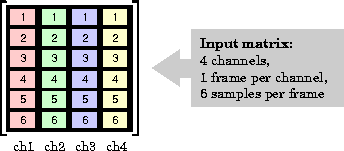 The Number of channels parameter specifies the number of independent channels (columns), N, in the matrix.
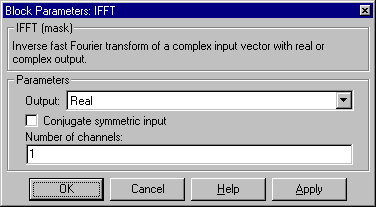
Select Complex from the Output parameter to output the full complex result of the IFFT.
The Number of channels parameter specifies the number of independent channels (columns), N, in the matrix.
Select Complex from the Output parameter to output the full complex result of the IFFT.
U = ifft(u) % equivalent MATLAB codeSelect Real to output only the real part of the result.
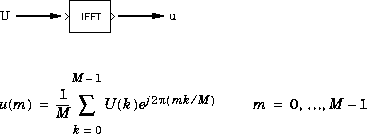
U = real(ifft(u)) % equivalent MATLAB codeIf the input to the block is conjugate symmetric, you should select the Conjugate symmetric input check box, which instructs the block to use an appropriate algorithm and generate a purely real output. A common source of conjugate symmetric data is the FFT block, whose output is conjugate symmetric when the input is purely real. The IFFT operation for a single-channel input (Number of channels =
1) is shown below.
Dialog Box
See Also
FFTifft (MATLAB)