
| Control System Toolbox | Search Help Desk |
| modred | Examples See Also |
Syntax
rsys = modred(sys,elim)
rsys = modred(sys,elim,'mdc')
rsys = modred(sys,elim,'del')
Description
modred
reduces the order of a continuous or discrete state-space model sys. This function is usually used in conjunction with balreal. Two order reduction techniques are available:
rsys = modred(sys,elim) or rsys = modred(sys,elim,'mdc') produces a reduced-order model rsys with matching DC gain (or equivalently, matching steady state in the step response). The index vector elim specifies the states to be eliminated. The resulting model rsys has length(elim) fewer states. This technique consists of setting the derivative of the eliminated states to zero and solving for the remaining states.
rsys = modred(sys,elim,'del')simply deletes the states specified by elim. While this method does not guarantee matching DC gains, it tends to produce better approximations in the frequency domain (see example below).
balreal and the gramians have  small diagonal entries, you can reduce the model order by eliminating the last
  states with
 modred.
Example
Consider the continuous fourth-order model
balreal by typing
h = tf([1 11 36 26],[1 14.6 74.96 153.7 99.65])
[hb,g] = balreal(h)
g'
MATLAB returns
ans =
   1.3938e-01   9.5482e-03   6.2712e-04   7.3245e-06
The last three diagonal entries of the balanced gramians are small, so eliminate the last three states with
modred using both matched DC gain and direct deletion methods.
hmdc = modred(hb,2:4,'mdc')
hdel = modred(hb,2:4,'del')
Both
hmdc and hdel are first-order models. Compare their Bode responses against that of the original model  .
.
bode(h,'-',hmdc,'x',hdel,'*')The reduced-order model
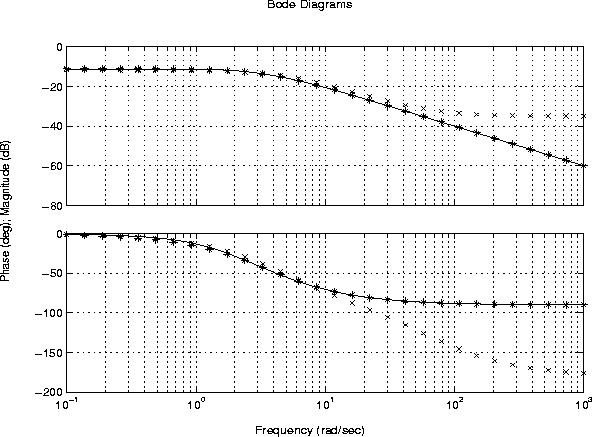
hdel is clearly a better frequency-domain approximation of  . Now compare the step responses.
step(h,'-',hmdc,'-.',hdel,'--')While
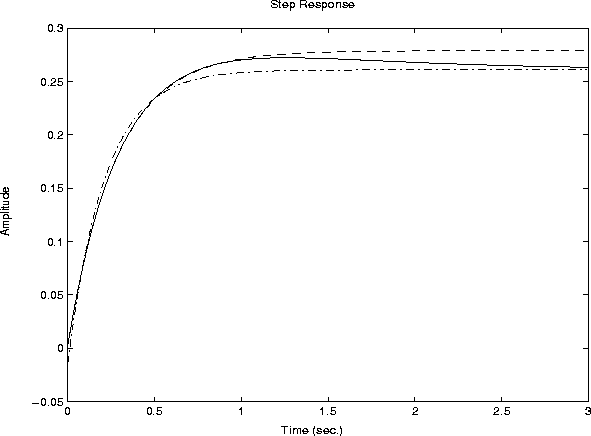
hdel accurately reflects the transient behavior, only hmdc gives the true steady-state response.
Algorithm
The algorithm for the matched DC gain method is as follows. For continuous-time models the state vector is partitioned into
  , to be kept, and
  , to be eliminated.
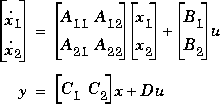
 is set to zero and the resulting equation is solved for
  . The reduced-order model is given by


Limitations
With the matched DC gain method, must be invertible in continuous time, and
  must be invertible in discrete time.
See Also
balreal minreal