
| Control System Toolbox | Search Help Desk |
| freqresp | Examples See Also |
Compute frequency response over grid of frequencies
Syntax
H = freqresp(sys,w)
Description
H = freqresp(sys,w)
computes the frequency response of the LTI model sys at the real frequency points specified by the vector w. The frequencies must be in radians/sec. For single LTI Models, freqresp(sys,w) returns a 3-D array H with the frequency as the last dimension (see "Arguments" below). For LTI arrays of size [Ny Nu S1 ... Sn], freqresp(sys,w) returns a [Ny-by-Nu-by-S1-by-...-by-Sn] length (w) array.
In continuous time, the response at a frequency  is the transfer function value at
  . For state-space models, this value is given by
w(1),..., w(N) are mapped to points on the unit circle using the transformation  where
where  is the sample time. The transfer function is then evaluated at the resulting
  values. The default
  is used for models with unspecified sample time.
Remark
Ifsys is an FRD model, freqresp(sys,w), w can only include frequencies in sys.frequency.
Arguments
The output argumentH is a 3-D array with dimensions

H(1,1,k) gives the scalar response at the frequency w(k). For MIMO systems, the frequency response at w(k) is H(:,:,k), a matrix with as many rows as outputs and as many columns as inputs.
Example
Compute the frequency response of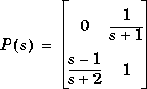
 . Type
w = [1 10 100]
H = freqresp(P,w)
H(:,:,1) =

        0            0.5000- 0.5000i
  -0.2000+ 0.6000i   1.0000


H(:,:,2) =

        0            0.0099- 0.0990i
   0.9423+ 0.2885i   1.0000


H(:,:,3) =

        0            0.0001- 0.0100i
   0.9994+ 0.0300i   1.0000
The three displayed matrices are the values of  for
for The third index in the 3-D array
 H is relative to the frequency vector w, so you can extract the frequency response at  rad/sec by
H(:,:,w==10)

ans =
        0            0.0099- 0.0990i
   0.9423+ 0.2885i   1.0000
Algorithm
For transfer functions or zero-pole-gain models,freqresp evaluates the numerator(s) and denominator(s) at the specified frequency points. For continuous-time state-space models  , the frequency response is

 is diagonalized for fast evaluation of this expression at the frequencies
  . Otherwise,
  is reduced to upper Hessenberg form and the linear equation
 is solved at each frequency point, taking advantage of the Hessenberg structure. The reduction to Hessenberg form provides a good compromise between efficiency and reliability. See [1] for more details on this technique.
Diagnostics
If the system has a pole on the axis (or unit circle in the discrete-time case) and
 w happens to contain this frequency point, the gain is infinite,  is singular, and
 freqresp produces the following warning message.
Singularity in freq. response due to jw-axis or unit circle pole.
See Also
evalfr Response at single complex frequency
bode Bode plot
nyquist Nyquist plot
nichols Nichols plot
sigma Singular value plot
ltiview LTI system viewer
References
[1] Laub, A.J., "Efficient Multivariable Frequency Response Computations," IEEE Transactions on Automatic Control, AC-26 (1981), pp. 407-408.