| Control System Toolbox | Search Help Desk |
| append | Examples See Also |
Group LTI models by appending their inputs and outputs
Syntax
sys = append(sys1,sys2,...,sysN)
Description
append
appends the inputs and outputs of the LTI models sys1,...,sysN to form the augmented model sys depicted below.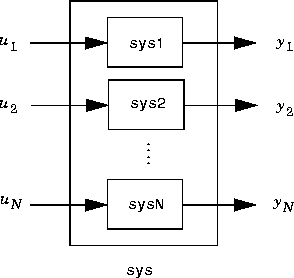
 ,...,
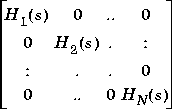
,..., , the resulting system
 sys has the block-diagonal transfer function
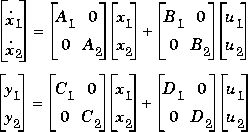
sys1 and sys2 with data 
 ,
, append(sys1,sys2) produces the following state-space model.
Arguments
The input argumentssys1,..., sysN can be LTI models of any type. Regular matrices are also accepted as a representation of static gains, but there should be at least one LTI object in the input list. The LTI models should be either all continuous, or all discrete with the same sample time. When appending models of different types, the resulting type is determined by the precedence rules (see "Precedence Rules" in the manual for details).
There is no limitation on the number of inputs.
Example
The commandssys1 = tf(1,[1 0]) sys2 = ss(1,2,3,4) sys = append(sys1,10,sys2)produce the state-space model
sys

a =
                        x1           x2
           x1            0            0
           x2            0      1.00000

b =
                        u1           u2           u3
           x1      1.00000            0            0
           x2            0            0      2.00000
c =
                        x1           x2
           y1      1.00000            0
           y2            0            0
           y3            0      3.00000

d =
                        u1           u2           u3
           y1            0            0            0
           y2            0     10.00000            0
           y3            0            0      4.00000

Continuous-time system.
See Also
connect Modeling of block diagram interconnections
feedback Feedback connection
parallel Parallel connection
series Series connection