| MATLAB Function Reference | Search Help Desk |
| bicgstab | Examples See Also |
BiConjugate Gradients Stabilized method
Syntax
x = bicgstab(A,b)
bicgstab(A,b,tol)
bicgstab(A,b,tol,maxit)
bicgstab(A,b,tol,maxit,M)
bicgstab(A,b,tol,maxit,M1,M2)
bicgstab(A,b,tol,maxit,M1,M2,x0)
x = bicgstab(A,b,tol,maxit,M1,M2,x0)
[x,flag] = bicgstab(A,b,tol,maxit,M1,M2,x0)
[x,flag,relres] = bicgstab(A,b,tol,maxit,M1,M2,x0)
[x,flag,relres,iter] = bicgstab(A,b,tol,maxit,M1,M2,x0)
[x,flag,relres,iter,resvec] = bicgstab(A,b,tol,maxit,M1,M2,x0)
Description
x = bicgstab(A,b)
attempts to solve the system of linear equations A*x = b for x. The coefficient matrix A must be square and the column vector b must have length n, where A is n-by-n. When A is not explicitly available as a matrix, you can express A as an operator afun that returns the matrix-vector product A*x for afun(x). This operator can be the name of an M-file, a string expression, or an inline object. In this case n is taken to be the length of the column vector b.
bicgstab will start iterating from an initial estimate that, by default, is an all zero vector of length n. Iterates are produced until the method either converges, fails, or has computed the maximum number of iterations. Convergence is achieved when an iterate x has relative residual norm(b-A*x)/norm(b) less than or equal to the tolerance of the method. The default tolerance is 1e-6. The default maximum number of iterations is the minimum of n and 20. No preconditioning is used.
bicgstab(A,b,tol)
specifies the tolerance of the method, tol.
bicgstab(A,b,tol,maxit)
additionally specifies the maximum number of iterations, maxit.
bicgstab(A,b,tol,maxit,M) and bicgstab(A,b,tol,maxit,M1,M2)
use left preconditioner M or M = M1*M2 and effectively solve the system inv(M)*A*x = inv(M)*b for x. You can replace the matrix M with a function mfun such that mfun(x) returns M\x. If M1 or M2 is given as the empty matrix ([]), it is considered to be the identity matrix, equivalent to no preconditioning at all. Since systems of equations of the form M*y = r are solved using backslash within bicgstab, it is wise to factor preconditioners into their LU factors first. For example, replace bicgstab(A,b,tol,maxit,M) with:
[M1,M2] = lu(M);
bicgstab(A,b,tol,maxit,M1,M2).
bicgstab(A,b,tol,maxit,M1,M2,x0)
specifies the initial estimate x0. If x0 is given as the empty matrix ([]), the default all zero vector is used.
x = bicgstab(A,b,tol,maxit,M1,M2,x0)
returns a solution x. If bicgstab converged, a message to that effect is displayed. If bicgstab failed to converge after the maximum number of iterations or halted for any reason, a warning message is printed displaying the relative residual norm(b-A*x)/norm(b) and the iteration number at which the method stopped or failed.
[x,flag] = bicgstab(A,b,tol,maxit,M1,M2,x0)
returns a solution x and a flag that describes the convergence of bicgstab. flag is not 0, the solution x returned is that with minimal norm residual computed over all the iterations. No messages are displayed if the flag output is specified.
[x,flag,relres] = bicgstab(A,b,tol,maxit,M1,M2,x0)
also returns the relative residual norm(b-A*x)/norm(b). If flag is 0, then relres 
tol.
[x,flag,relres,iter] = bicgstab(A,b,tol,maxit,M1,M2,x0)
also returns the iteration number at which x was computed. This always satisfies 0 iter maxit. iter may be an integer or an integer + 0.5, since bicgstab may converge halfway through an iteration.
[x,flag,relres,iter,resvec] = bicgstab(A,b,tol,maxit,M1,M2,x0)
also returns a vector of the residual norms at each iteration, starting fromresvec(1) = norm(b-A*x0). If flag is 0, resvec is of length 2*iter+1, whether iter is an integer or not. In this case, resvec(end) tol*norm(b).
Example
load west0479
A = west0479
b = sum(A,2)
[x,flag] = bicgstab(A,b)
flag is 1 since bicgstab will not converge to the default tolerance 1e-6 within the default 20 iterations.
[L1,U1] = luinc(A,1e-5)
[x1,flag1] = bicgstab(A,b,1e-6,20,L1,U1)
flag1 is 2 since the upper triangular U1 has a zero on its diagonal so bicgstab fails in the first iteration when it tries to solve a system such as U1*y = r with backslash.
[L2,U2] = luinc(A,1e-6)
[x2,flag2,relres2,iter2,resvec2] = bicgstab(A,b,1e-15,10,L2,U2)
flag2 is 0 since bicgstab will converge to the tolerance of 2.9e-16 (the value of relres2) at the sixth iteration (the value of iter2) when preconditioned by the incomplete LU factorization with a drop tolerance of 1e-6. resvec2(1) = norm(b) and resvec2(13) = norm(b-A*x2). You can follow the progress of bicgstab by plotting the relative residuals at the halfway point and end of each iteration starting from the intial estimate (iterate number 0) with semilogy(0:0.5:iter2,resvec2/norm(b),'-o')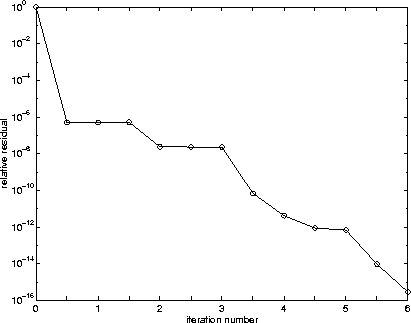
See Also
bicg, cgs, gmres, luinc, pcg, qmr
The arithmetic operator \
References
van der Vorst, H. A., "BI-CGSTAB: A fast and smoothly converging variant of BI-CG for the solution of nonsymmetric linear systems", SIAM J. Sci. Stat. Comput., March 1992,Vol. 13, No. 2, pp. 631-644. "Templates for the Solution of Linear Systems: Building Blocks for Iterative Methods", SIAM, Philadelphia, 1994.