 |
If some activity or its result can considerably influence
the environment of human health and safety, Environmental
Impact Assessment (EIA)* is needed to assess the potential
environmental impact and elaborate proposals for prevention
or reduction of the negative impact. Environmental Impact
Assessment is a systematic procedure with a main aim to predict
and prevent the potential negative impact of physical planning
activities upon the environment and society. Development can
influence not only physical environment (pollute water, air
and soil, stink, enhance noise and electromagnetic radiation
level), but also economic and social environment of the territory.
Economic and social changes in their turn can alter the structure
of the society, frequently causing irreversible changes on
the labour market, in service field (health and social protection,
education), life style and cultural values. That is why it
is necessary to assess potential impact of the proposed action
upon all aspects.
EIA
is a preventive procedure- the potential impact is
being planned theoretically according to the accessible
information. Its main aim is:
|
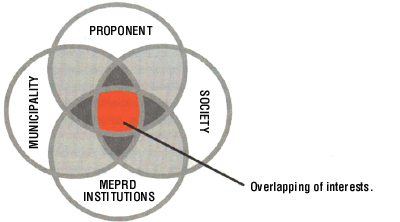
Several interests are being
harmonised to make a final decision about the realisation
of the project. Main interest groups, involved in
the process are:
|
-
to help with the decision-making process,
-
to help with the formulation of development aims,
-
to ensure sustainable development.
|
-
proponent,
-
municipal authorities,
-
institutions subordinated to the Ministry of Environmental
Protection and Regional Development,
-
society.
|
| *
The Environmental Impact Assessment procedure is described
in the law "On Environmental Impact Assessment" (in force
from November 13, 1998) and in the Cabinet of Ministers
Regulations No. 213 "Procedures for Environmental Impact
Assessment" (in force from June 19, 1999). |
|
|
|
|


